

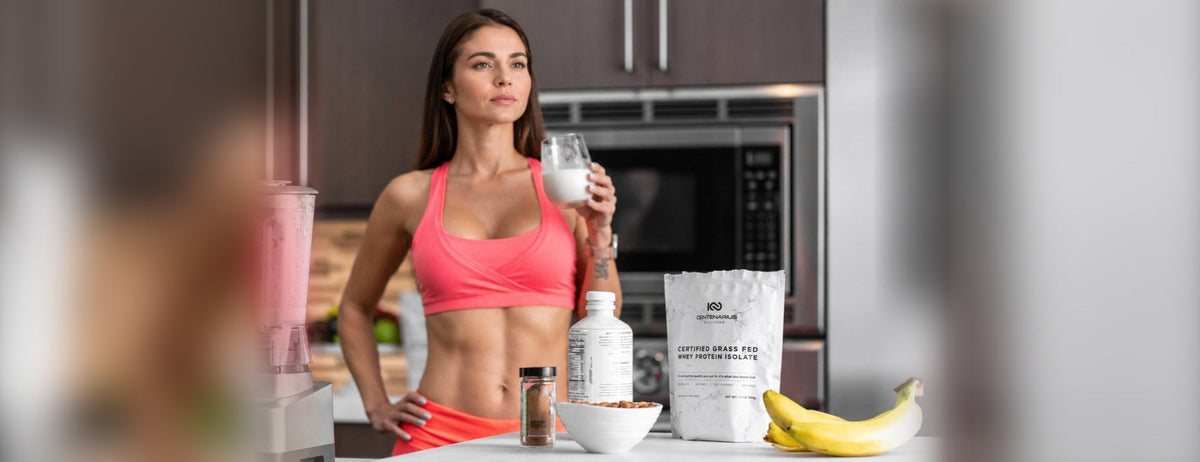
Protein is the foundation I build almost every plan around for women over 40. It's what helps you stay strong, keep your muscle and age well. Yet most women I work with eat far less than they need.
How much protein do women need after 40? The short answer: the new 2025-2030 Dietary Guidelines recommend 1.2 to 1.6 g of protein per kilogram of body weight a day (about 0.55 to 0.73 g per pound), up from the old minimum of 0.8 g/kg (0.36 g per pound). For a 139 lb (63 kg) woman, that's about 76 to 101 g a day. Aim for the higher end if you strength train or are losing weight.
Key takeaways
- The 2025-2030 Dietary Guidelines raised the protein recommendation to 1.2 to 1.6 g/kg a day (0.55 to 0.73 g per pound).
- The old RDA of 0.8 g/kg (0.36 g per pound) is a minimum to avoid deficiency, not a target for healthy aging.
- After 40, and especially through menopause, muscles respond less to the same amount of protein, so getting enough matters more.
- Divide your daily target across your meals: for most women, that's about 25 to 40 g per meal, plus a protein snack if needed.
- Protein works best together with strength training.
How much protein do women over 40 need each day?
The 2025-2030 Dietary Guidelines for Americans, released in January 2026, recommend 1.2 to 1.6 g of protein per kilogram of body weight a day (about 0.55 to 0.73 g per pound), adjusted to your calorie needs. That's 50 to 100% more than the long-standing RDA of 0.8 g/kg (0.36 g per pound), which remains the minimum. To convert pounds to kilograms, divide by 2.2.
| Body weight | Minimum (RDA, 0.8 g/kg or 0.36 g/lb) | Recommended (1.2 to 1.6 g/kg or 0.55 to 0.73 g/lb) |
|---|---|---|
| 121 lb (55 kg) | 44 g | 66 to 88 g |
| 139 lb (63 kg) | 50 g | 76 to 101 g |
| 165 lb (75 kg) | 60 g | 90 to 120 g |
| 198 lb (90 kg) | 72 g | 108 to 144 g |
Expert groups on healthy aging (PROT-AGE and ESPEN) also recommend at least 1.0 to 1.2 g/kg (0.45 to 0.55 g per pound) for older adults, and 1.2 g/kg (0.55 g per pound) or more for those who are active (Bauer 2013; Deutz 2014).
What about the "1 gram per pound" rule? That works out to about 2.2 g/kg. A large meta-analysis of 49 trials found muscle gains from protein levelled off around 1.6 g/kg (0.73 g per pound) a day (Morton 2018), so you don't need to go that high.
Why do protein needs change after 40?
As we age, muscles respond a little less to the same meal. Researchers call this anabolic resistance: the same amount of protein triggers a smaller muscle-building response than it did at 25. That's why getting enough protein matters more with every decade. In practice:
- Eat enough protein across the day.
- Spread it over your meals: divide your daily target by the number of meals you eat. With 3 meals, that's often 30 to 40 g each, or add a protein snack.
- Add strength training, which multiplies the benefit of protein.
In a meta-analysis of 18 trials, eating more protein than the RDA helped people build or keep lean muscle during strength training and weight loss (Hudson 2020).
Is there a 25 g limit on protein per meal?
No. The idea that your body can only use 20 to 30 g at once is a myth. In a 2023 trial, a 100 g dose of protein after a workout produced a longer-lasting muscle-building response than 25 g, and the extra protein wasn't wasted (Trommelen 2023). That study was in young men, but it means you don't need to worry about a "limit." Simply divide your daily target across your meals.
Is 100 grams of protein too much for a woman?
Not for most active women. For a 139 lb (63 kg) woman, 100 g is about 1.6 g/kg (0.73 g per pound) a day, the top of the new guidelines' range. It's a great target if you strength train or are losing weight. If you're less active, 75 to 90 g a day fits the guidelines well.
What does 30 g of protein actually look like?
30 g of protein doesn't mean 30 g of chicken or meat. Most protein foods are mostly water, fat or carbs, so the protein is only part of the weight. Approximate amounts:
| Food | Serving | Protein (approx.) |
|---|---|---|
| Chicken breast, cooked | 3.5 oz (100 g) | about 31 g |
| Salmon, cooked | 3.5 oz (100 g) | about 25 g |
| Eggs | 2 large | about 12 g |
| Greek yogurt, plain nonfat | 1 cup (about 7 oz / 200 g) | about 20 g |
| Lentils, cooked | 1 cup (about 7 oz / 200 g) | about 18 g |
So a palm-sized portion of chicken gives you about 30 g, while two eggs alone give you less than half of that. That's why many women fall short without realizing it.
How do you reach your protein target?
To find your own daily number in seconds, use our protein calculator.
Start with protein at every meal: eggs, Greek yogurt, fish, poultry, meat, beans, lentils and tofu. If you're still short, a protein powder is an easy way to close the gap, especially when appetite or time is limited.
Choose your powder carefully. In 2025, Consumer Reports tested 23 protein powders and shakes and found that more than two-thirds had more lead in a single serving than its experts consider safe for a whole day. That's why I only recommend powders that are 3rd-party tested for heavy metals.
How long until it works?
With enough protein and regular strength training, changes in muscle build over weeks to months. The trials in the large meta-analysis ran at least six weeks.
Is high protein safe for your kidneys?
For healthy kidneys, yes. A meta-analysis of 28 trials found that higher protein intake didn't change kidney function in people with healthy kidneys (Devries 2018).
Before you start
Check with your doctor first if you: have kidney disease or reduced kidney function, gout or a history of kidney stones, have had bariatric surgery, take any medication, or are pregnant or breastfeeding.
Not All Protein Is Created Equal
I believe quality matters. I always choose clean ingredients of the highest quality, which is why the protein I use every day, and the one I recommend in my practice, is Centenarius Grass-Fed Whey Protein Isolate.
- 27 g of complete protein per serving, with all 9 essential amino acids and 6.7 g of naturally occurring BCAAs.
- Truly Grass Fed® Irish whey, with no fillers, artificial flavors or sweeteners.
- Truly unflavored, so it mixes with everything. Stir it into coffee, yogurt, oatmeal or a smoothie, or simply mix it with water.
- Gentle and easy to digest. Filtered with cold cross-flow microfiltration, so it's virtually lactose-free and light on the stomach.*
- 3rd-party independently tested for heavy metals and purity, with the lab report linked on the product page.
A simple example: if your target is 76 g and your meals give you about 55 g, one serving closes the gap.
Questions I'm often asked
How much protein should a woman over 40 eat per meal? Divide your daily target by the number of meals you eat. If you eat 3 meals a day and need 100 g, that's about 33 g per meal, or less if you add a protein snack. There's no hard ceiling, and larger servings still count.
Does the body only absorb 20 to 30 g of protein at once? No. In a 2023 trial, 100 g of protein after a workout produced a longer muscle-building response than 25 g.
Is 1 gram of protein per pound necessary? No. That's about 2.2 g/kg a day, above the point where research found extra muscle gains level off, around 1.6 g/kg (0.73 g per pound).
How much protein after 50 helps maintain muscle? The new Dietary Guidelines recommend 1.2 to 1.6 g/kg (0.55 to 0.73 g per pound) a day, and expert groups on aging recommend at least 1.0 to 1.2 g/kg (0.45 to 0.55 g per pound). Pair it with strength training for the best results.
What changed in the 2025-2030 Dietary Guidelines? For the first time, they recommend 1.2 to 1.6 g of protein per kg of body weight a day (0.55 to 0.73 g per pound), adjusted to calorie needs, and encourage protein at every meal.
Should women over 40 use protein powder? It's a convenient, high-quality way to reach your target when meals fall short. Just choose one that's 3rd-party tested for heavy metals.
References
- U.S. Department of Agriculture and U.S. Department of Health and Human Services. Dietary Guidelines for Americans, 2025-2030. January 2026. realfood.gov
- Oklahoma State University Extension. The New Dietary Guidelines for Americans (2025-2030). extension.okstate.edu
- Bauer J, et al. Evidence-based recommendations for optimal dietary protein intake in older people: a position paper from the PROT-AGE Study Group. J Am Med Dir Assoc. 2013;14(8):542-559. doi:10.1016/j.jamda.2013.05.021
- Deutz NEP, et al. Protein intake and exercise for optimal muscle function with aging: recommendations from the ESPEN Expert Group. Clin Nutr. 2014;33(6):929-936. pubmed.ncbi.nlm.nih.gov
- Morton RW, et al. A systematic review, meta-analysis and meta-regression of the effect of protein supplementation on resistance training-induced gains in muscle mass and strength in healthy adults. Br J Sports Med. 2018;52(6):376-384. pubmed.ncbi.nlm.nih.gov
- Hudson JL, et al. Protein intake greater than the RDA differentially influences whole-body lean mass responses to purposeful catabolic and anabolic stressors: a systematic review and meta-analysis. Adv Nutr. 2020;11(3):548-558. doi:10.1093/advances/nmz106
- Trommelen J, et al. The anabolic response to protein ingestion during recovery from exercise has no upper limit in magnitude and duration in vivo in humans. Cell Rep Med. 2023;4(12):101324. doi:10.1016/j.xcrm.2023.101324
- Devries MC, et al. Changes in kidney function do not differ between healthy adults consuming higher- compared with lower- or normal-protein diets: a systematic review and meta-analysis. J Nutr. 2018;148(11):1760-1775. pubmed.ncbi.nlm.nih.gov
- Consumer Reports. Protein powders and shakes contain high levels of lead. October 2025. consumerreports.org


